What to Wear for a Pooja at Home – Men's Guide

Home poojas have a weird way of catching you off guard. Someone mentions "pooja hai kal subah" the night before, and suddenly you're standing in front of your wardrobe at 7 AM wondering if jeans and a kurta count, or if that's disrespectful, or if you're overthinking a Tuesday morning ritual that your grandfather used to do in a lungi without a second thought.
Turns out there's a reasonable middle ground here, and it's simpler than most people make it.
The Basic Rule Nobody Tells You
Comfort matters more than most guides admit. A home pooja usually means sitting cross-legged on the floor for a while, standing up, sitting back down, maybe helping move things around the mandir — this isn't a wedding where you're posing for photos all day. Whatever you wear needs to survive that movement without riding up, pinching, or making you constantly adjust yourself mid-aarti.
That rules out a lot of "formal" options right away. Stiff fabrics, tight-fit anything, jeans with a belt that digs in when you sit down — all technically fine to wear, all mildly miserable for an hour of floor-sitting.
Kurta Pyjama Is Still the Safest Bet
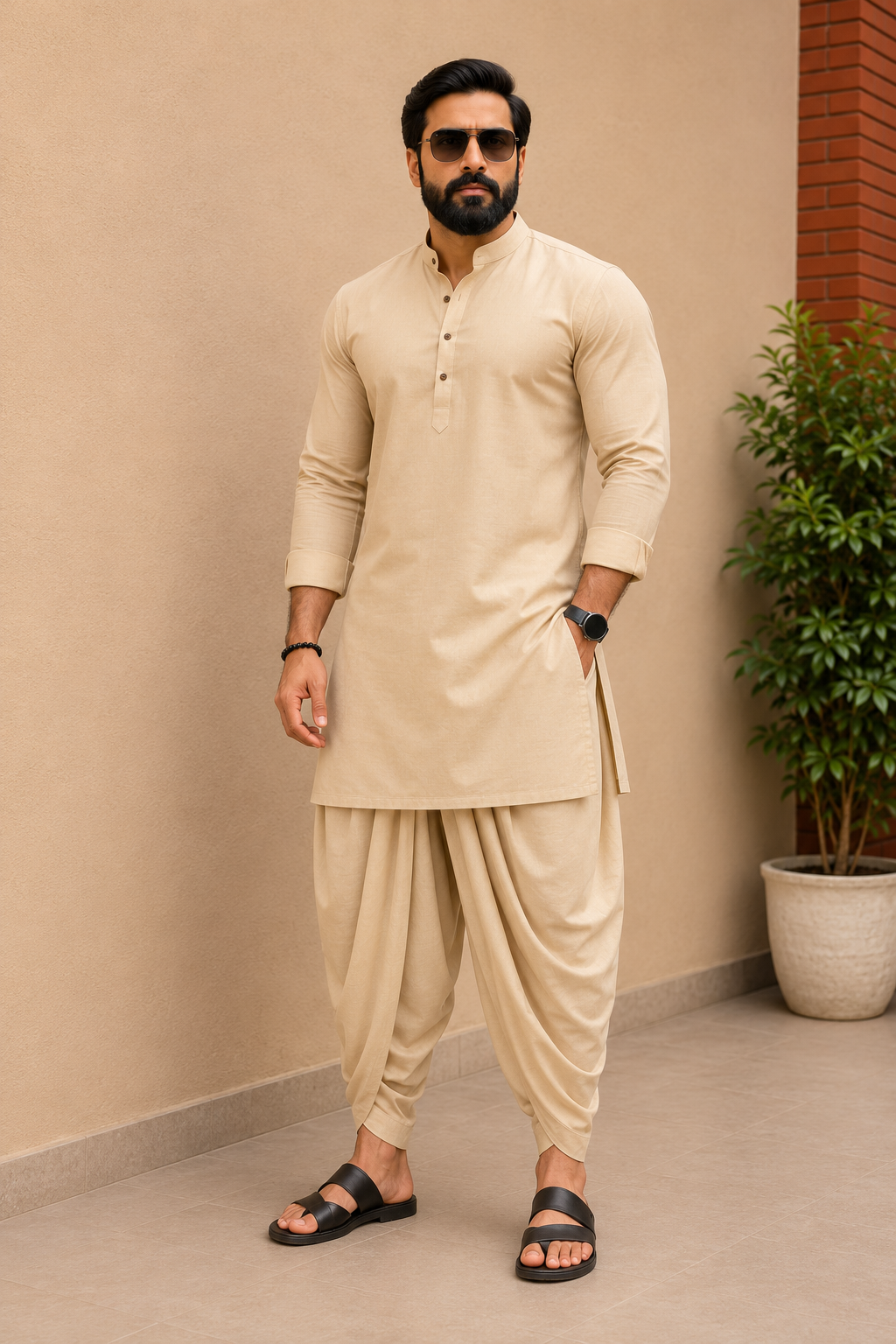
Not because it's the only "correct" option, but because it's built for exactly this scenario. A soft cotton kurta with a matching or contrasting pyjama gives you the range of motion a pooja actually needs — sitting, bending, standing — without any of it feeling restrictive.
For a regular home pooja, a short kurta works fine. It doesn't need to be the knee-length festive one you'd wear to a wedding. Something simple, breathable, maybe with a chest pocket for convenience, does the job without making the occasion feel bigger than it is.
Colour-wise, you don't need to follow strict rules unless a specific ritual calls for one — some families do prefer avoiding black for certain poojas, which is more of a regional or family tradition than a universal rule. White, cream, yellow, or any light, breathable colour tends to be the default, mostly because they're practical for something that might involve sitting near a diya or handling turmeric and kumkum.
If You'd Rather Skip the Kurta
Not everyone owns one, and that's fine too. A simple cotton shirt with pyjama-style pants or even loose cotton trousers works reasonably well. The goal is the same — breathable fabric, nothing tight around the waist, nothing that restricts you from sitting on the floor comfortably.
What you want to avoid here is anything overly casual to the point of looking careless — a wrinkled t-shirt and shorts might be comfortable, but it reads more "just woke up" than "participating in a ritual." There's a difference between relaxed and unbothered, and pooja mornings usually call for the former.
The Dhoti Question
Some families still prefer a dhoti for pooja, especially older generations or during specific festivals. If that's your household's tradition, a ready-to-wear, pre-stitched dhoti solves the one problem that used to make dhotis annoying — the constant re-tying. You get the traditional look without needing to know the actual draping technique, which, if we're honest, most younger guys today were never taught properly anyway.
If your family doesn't specifically expect a dhoti, you're not under any obligation to wear one just because it feels "more traditional." A kurta pyjama carries the same respect without the learning curve.
What About Bigger Occasions — Satyanarayan Pooja, Griha Pravesh, Festivals
For anything slightly bigger than a routine morning pooja — a Satyanarayan pooja, griha pravesh, or a major festival like Diwali or Ganesh Chaturthi — it's worth stepping up slightly. This is where a long kurta actually makes sense, paired with a dhoti or matching pyjama. It signals that you've made a bit of effort for the occasion without needing to go full wedding-guest mode.
These are also the events where colour gets a little more attention — families dressing up together, photos being taken, that sort of thing. A deeper colour like maroon or a festive yellow works well here, mostly because it photographs better and fits the slightly elevated nature of the event compared to a regular weekday pooja.
Things That Are Genuinely Fine to Skip
A few things people stress about that really don't matter much: you don't need brand-new clothes for every pooja, you don't need to iron a kurta to perfection if it's just a home ritual, and you don't need to match your outfit to anyone else's unless it's a family photo situation. The fabric being clean and the outfit being reasonably presentable covers most of what actually matters.
Footwear is worth a mention too, mostly because it's the one thing people forget until they're standing at the door. Since footwear comes off before entering the pooja area anyway, this isn't something to overthink — slip-on sandals or juttis make the process easier than fighting with laces right before you're supposed to be sitting calmly for an aarti.
A Simple Way to Decide, Fast
If it's a regular home pooja — light cotton kurta with pyjama, or even a simple shirt and comfortable pants, done.
If it's a bigger occasion with guests, photos, or a specific family tradition around dhotis — long kurta with a dhoti or matching pyjama, in a colour that feels a little more festive than your everyday choices.
Either way, the fabric should breathe, the fit shouldn't restrict you from sitting on the floor, and the colour should feel appropriate for the moment without requiring a shopping trip every single time. Most of this comes down to having two or three reliable pieces in the wardrobe already, so the "what do I wear" question stops being a morning-of scramble.